
Settings & customization
Settings
Choose how you write, connect your research tools, and manage local storage.
Open Settings from the gear in the rail or the command palette. Settings apply to this computer; a project’s engine, main document, and other project choices travel with its files.
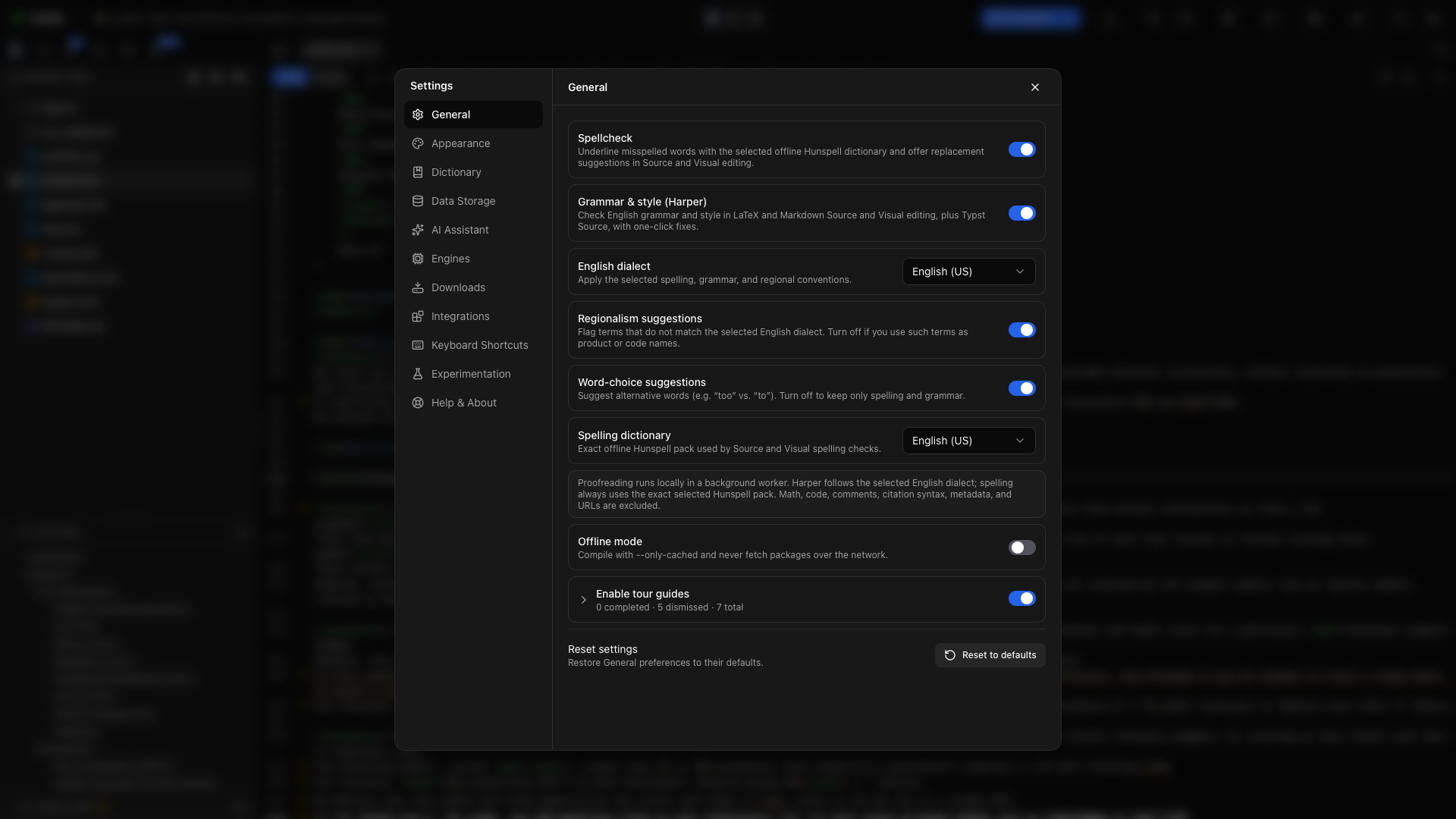
General
Section titled “General”Choose the app language, set up tours, control proofreading, and turn offline compilation on or off. Oleafly currently offers English and Simplified Chinese; System follows your operating system when it matches a supported language. The interface changes immediately.
Every General control has its own explanation. Offline mode tells Tectonic to use cached packages and disables network citation lookups. Read Compiling before taking a new project offline.
Appearance
Section titled “Appearance”Choose a light or dark theme, an accent color, a background, and fonts for the app and editor. Adjust text sizes and choose whether projects open in split view, editor only, or PDF only. Editor controls here include automatic completion, bracket, math, and environment pairing, sticky context, Vim mode, and inline suggestions. You can also control the file tree and library PDF previews.
Dictionary
Section titled “Dictionary”Review the words you have ignored for This project or All projects. Remove a word to include it in proofreading again. See Spelling & grammar.
Data Storage
Section titled “Data Storage”See where your library lives and how much space projects, files, Git history, and build caches use. Control automatic checkpoints and their storage notices under Local store. Manage local storage here and follow Where your data lives when making a backup.
AI Assistant
Section titled “AI Assistant”| Tab | What you can set up |
|---|---|
| Providers and keys | Cloud providers, compatible endpoints, local models, the model picker, project approvals, and budgets. |
| CLI agents | Install, connect, and configure agents that run on your computer. |
| Instructions | Writing instructions, model defaults, PDF capture, and the tool catalog. |
| Personas | Named instruction presets for different kinds of work. |
| Skills | Research workflows, domain guidance, and your own reusable skills. |
| MCP | External tools the assistant can use, including server discovery and configuration import. |
Start with Set up AI. Read CLI agents, Skills, and Usage & budgets for the individual controls.
Engines
Section titled “Engines”Manage the tools that compile your documents. For LaTeX, Oleafly can detect a system TeX installation or install its own TinyTeX. Package management and tagged PDF setup live here. See LaTeX engines & packages.
Downloads
Section titled “Downloads”Download template and font packs, and manage AI templates saved to your gallery. See Templates.
Integrations
Section titled “Integrations”| Tab | What it connects |
|---|---|
| GitHub | Your account for publishing, pulling, and pushing projects. |
| alphaXiv | Paper tools for the assistant. |
| Zotero | References from your Zotero library. |
| Citation search | Research search services and their credentials. |
| Oleafly MCP | Oleafly’s local server for an external assistant to work with your project. |
An external MCP tool connects under AI Assistant → MCP. An external assistant connects to Oleafly through Integrations → Oleafly MCP. The MCP guide covers both directions.
Keyboard Shortcuts
Section titled “Keyboard Shortcuts”Search the shortcut list and record replacements for the app actions that support customization. Editor bindings are listed alongside app commands. See Keyboard shortcuts.
Experimentation
Section titled “Experimentation”Enable the features you want to try:
- Visual editor adds the Code / Visual switch for prose editing.
- LaTeX tools shows the 37-tool gallery and its slash commands. The Oleafly Tools guide covers every converter, reference builder, research utility, checker, and writing helper.
- Web browser enables the browser window and its assistant tools.
These options are off by default. Turn them on here before following a guide that uses them.
Help & About
Section titled “Help & About”Check the app version, restart a tour, open documentation, or report a problem. Copy Info gathers version and system details for a bug report.
Read the individual guides for Appearance, Downloads, Storage, and Help.